
AI & data foundations
AI for business: why your data matters more than your prompts
Useful business AI connects finance, sales, capacity and operations. Reliable answers start with shared definitions, connected data and controlled analytical tools—not a more elaborate prompt.
By DataTalks · · 4 min read
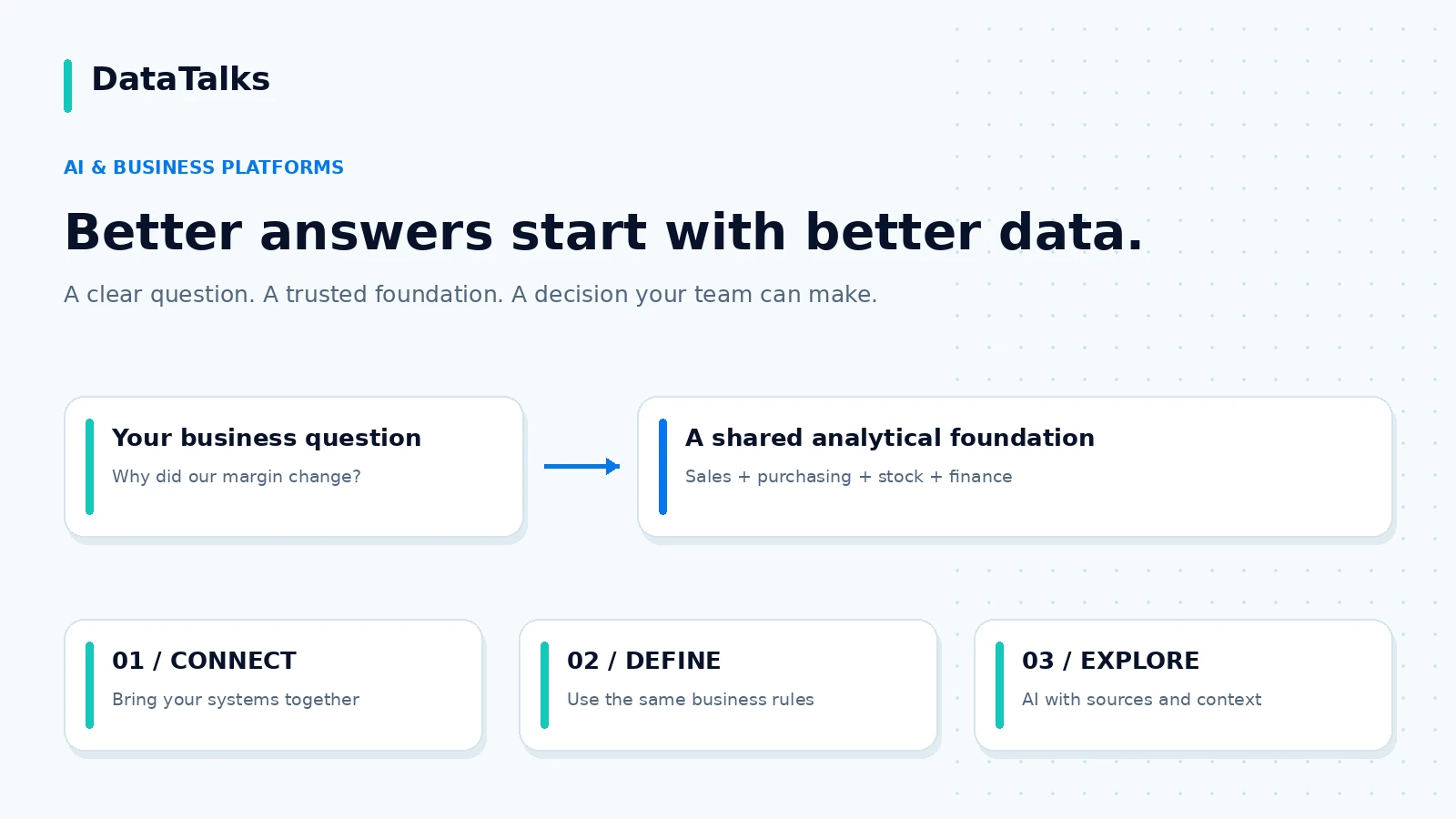
Which teams are working beyond capacity? Why does one site use more materials than the others? Is this business unit underperforming, or are we comparing two very different periods?
The answers rarely live in one system. Sales may sit in a CRM, invoices in an ERP, working hours in a planning tool and stock movements in an operational application. Calendar information and delivery constraints add another layer.
AI can help explore these connections. But a better prompt cannot compensate for missing information, mismatched records or unclear measures. Useful analysis starts with a shared data foundation and a controlled way to coordinate the work across it.
Connect demand and capacity to understand performance
Consider a question from a service organisation: compare delivered work with actual team hours, and identify where capacity needs a closer review.
A monthly revenue total can hide an overloaded team alongside another waiting for work. Connecting delivery records, assignments and worked hours makes those differences easier to investigate. The right measure depends on the business: completed jobs per worked hour, project contribution margin or revenue per delivery hour may each answer a different question.
These measures need context. Invoicing dates may not match the dates work was performed. Training, preparation, quality checks and non-billable support still consume capacity. Comparing teams without accounting for their responsibilities can reward the wrong behaviour.
For an illustrative logistics business, fewer completed deliveries per hour might reflect longer routes or more complex handling requirements rather than a staffing problem. Linking deliveries, route characteristics and worked hours gives a manager a more useful starting point than a company-wide average.
A follow-up question becomes: is the gap persistent for comparable routes, or concentrated around holidays and unusual demand? AI can help explore that pattern when the relevant records fit together. The manager still needs to validate the interpretation before changing schedules or targets.
Compare resource usage with the activity behind it
The same principle applies to purchasing, inventory and production. A site using more material is not necessarily wasting more. It may simply process more orders or handle a different product mix.
In a clearly illustrative manufacturing scenario, one workshop appears to consume more packaging than another. Comparing total purchases alone tells us little. A useful investigation connects production quantities, packaging specifications, stock movements and recorded scrap over comparable periods.
That comparison can highlight where actual usage differs from expected usage. It cannot, by itself, prove the cause. Rework, damaged materials, recording errors and specification changes are possibilities for the operational team to check—not conclusions for an assistant to invent.
Purchases must also be distinguished from consumption. A large delivery may increase inventory without changing what the workshop used that week. Returns, transfers and opening stock matter when reconstructing usage.
The practical value is a more focused investigation: which site, product or period deserves attention, which records support the finding and what information is still missing? That is a better outcome than an impressive answer with no way to verify it.
A data foundation and orchestration make the analysis possible
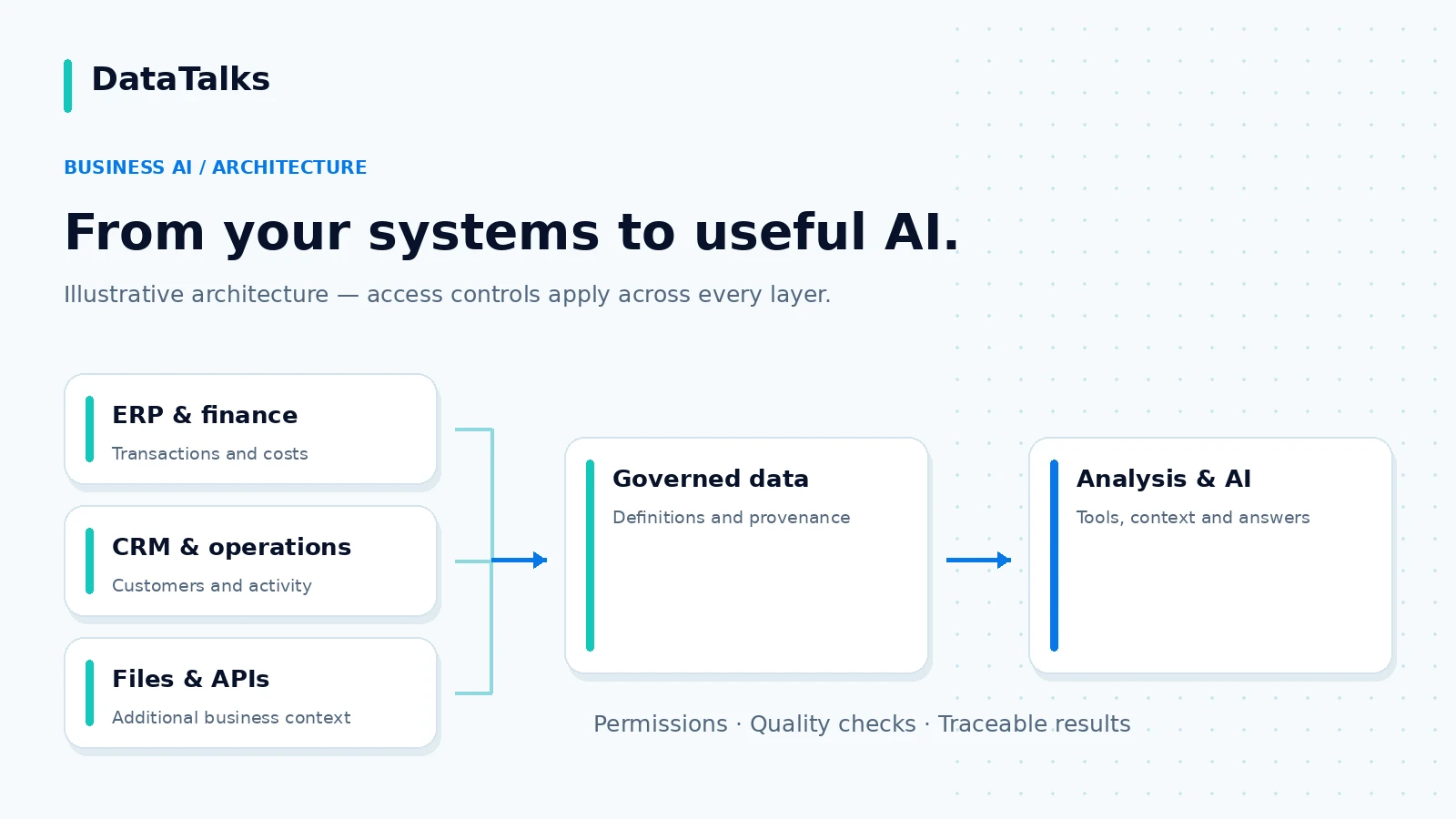
These questions require more than giving an AI assistant access to several applications. Records need to refer to the same customer, project, site and period. Measures must have consistent meanings. Otherwise, an answer can sound convincing while combining figures that do not belong together.
Data engineering creates that shared foundation: connectors collect information from existing systems, transformations harmonise it and quality checks flag missing or inconsistent records. A warehouse and governed business models can then support reporting, custom applications and AI without each interface redefining the calculations.
An orchestration layer coordinates the next step. It connects a question to approved analytical tools, supplies the relevant parameters and brings their results together so the assistant can explain the findings. For capacity, that might mean combining workload, actual hours and comparable periods. For material usage, it might mean connecting production, stock movements and expected quantities.
MCP—Model Context Protocol—is an open standard for connecting AI applications to external tools and data. Where supported by your chosen assistant, it can provide an interface to those analytical tools. It does not replace data preparation, access controls or the business rules behind the tools.
Keep permissions explicit and begin with read-only analysis where appropriate. An assistant explaining a cash forecast should identify the records and assumptions behind it; approving a payment or changing a schedule is a separate action that needs its own permissions and approval process.
Start with one business decision
Choose a recurring decision you want to improve: allocating delivery capacity, investigating material usage or reviewing the cash forecast. Identify who makes it, which evidence they need and what would make the answer useful.
Connect the necessary sources, agree the measures and test the results against a known report or a manually checked sample. Then use AI to explore the information and ask follow-up questions, keeping source references, refresh dates and limitations visible.
You do not need to automate every workflow or centralise every dataset before learning something useful. A focused first version can establish the definitions, access rules and integration patterns that later reporting and platform features reuse.
At DataTalks, we build this connection between existing systems, trusted data and the custom tools teams need. AI is one interface to that foundation, alongside dashboards and operational workflows—not a substitute for it.
The objective is a shorter path from a business question to evidence your team can verify and act on.